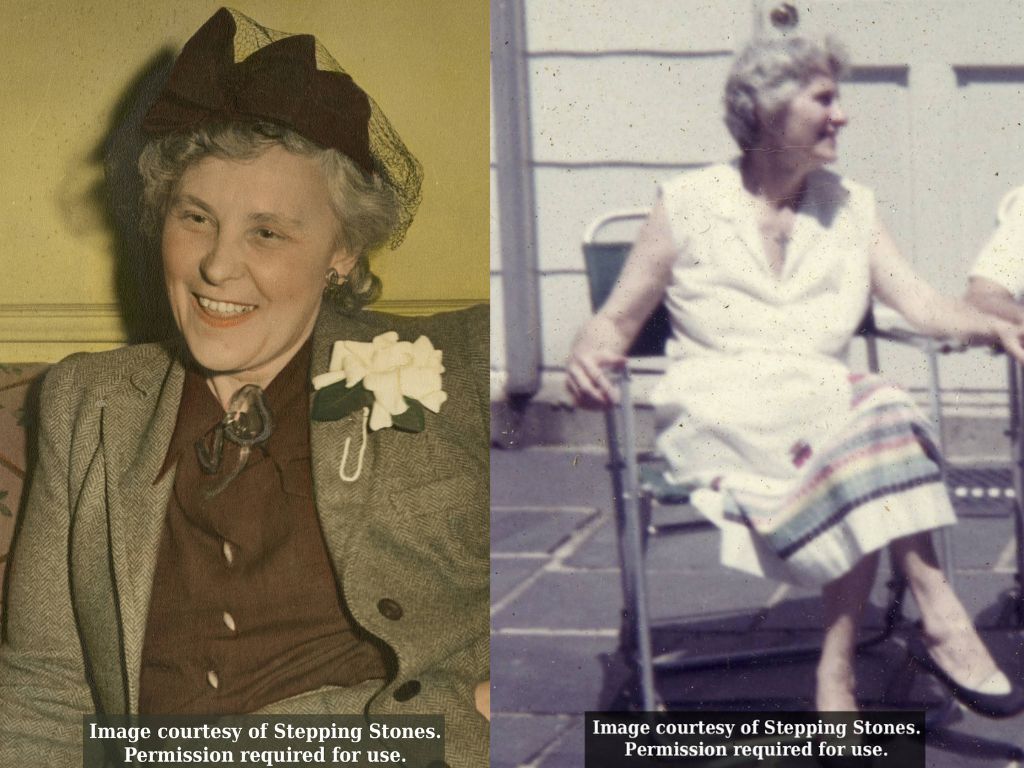
Seventy-five years ago tomorrow, April 22, 1951, Lois Wilson hosted a lunch at her Stepping Stones home for the wives of A.A. members from the U.S. and Canada attending the A.A. General Service Conference in NY, her neighbor and friend Anne Bingham and other wives of local and regional members of “wives’ groups”. This little-known meeting was the first step towards a Clearing House, the precursor of the Al-Anon Family Groups, a world-wide Twelve Step fellowship for families and friends of people with drinking problems.
Contrast this humble beginning when thousands gather in Akron, Ohio for Founders Day weekend to commemorate June 10, 1935, when co-founder Dr. Bob Smith had his last drink after meeting Bill Wilson. Many A.A. members recognize June 10,1935 as the founding of A.A. The conversation between these two men has grown into a world-wide fellowship which includes 33,000 A.A. members with spouses and friends gathering in Vancouver, British Columbia for Alcoholics Anonymous’s International Convention with Al-Anon participation in July 2025 to celebrate A.A.’s 90th year.
Early in Al-Anon’s life, Bill Wilson expected Al-Anon to become much larger than A.A., because for every one person with a drinking problem in recovery, there are four or more family members who are impacted. Sadly, Al-Anon’s growth has been modest compared with A.A.
Both A.A. and Al-Anon are world-wide – A.A. in 180 nations and Al-Anon in 118. A.A. has about 123,000 groups compared with Al-Anon’s 24,000, underscoring A.A.’s far greater reach, estimated at 2 million members.
The 75th anniversary of Al-Anon is a great time to explore why its growth didn’t meet Bill Wilson’s expectations. From the very beginning of A.A., attention was paid to both individual and family recovery. New members of A.A. often attended with their wives or spouses. The “Big Book” includes a chapter, The Family Afterwards, and references the need for a period of “reconstruction” in the family home.
Lois and Bill Wilson were clear that alcoholism was a “family disease.” Adapting to the behavior of the drinking alcoholic causes physical and mental health issues for everyone in the family. Recovery from alcoholism, or any addiction, is not a solo job. It requires changed attitudes and behaviors for spouses, children and other family members.
By 1951 family groups had already sprung up in 87 communities in the U.S., Canada, and a small number of overseas countries. These spouses, mostly wives of men getting sober in newly formed A.A. groups, came together and decided they also needed to change through the use of the same Twelve Steps their husbands were embracing. Beginning with Anne Smith, wife of A.A. co-founder Dr. Bob Smith of Akron and Lois Wilson, a precursor activity was when wives and spouses would gather – often in kitchens – outside the meetings of the alcoholics.
Lois and Anne Bingham wrote to these groups and individuals in May 1951 and asked if they’d like to be part of a newly forming Clearing House of Family Groups. Forty-eight groups said “yes.” They also asked about following the Twelve Steps and raised the question of a name. These early pioneer respondents agreed to adopt the Twelve Steps and chose the name Al-Anon Family Groups. The name – an abbreviation of Alcoholics Anonymous – reflects the intent that A.A. and Al-Anon work closely together to advance individual and family recovery.
There are many possible explanations for why Al-Anon has not grown as quickly as A.A. While Lois and Bill were alive, they were the link that connected A.A. and Al-Anon. After Lois’s death in 1988, other factors put more emphasis on the need for independence and “singleness of purpose” for both organizations. The practice of spouses, partners and members of A.A. and Al-Anon coming together to celebrate and encourage family recovery became more complex and occurred less frequently. More discussion is needed on how to reconnect A.A. and Al-Anon and other family programs.
There is one reason that stands out for expanding access to family recovery worldwide.
Too many people are dying or having their lives harmed and limited because of exposure to alcoholism and other addictions. Stigma and cultural incentives toward escape through alcohol, drugs, and other behaviors mean the full toll is rarely counted.
The numbers that do exist make a compelling case that attention to the individual with an addiction is not enough. There are 488 deaths each day – 20 people every hour, 178,120 per year – from excessive alcohol use in the U.S. Over 105,000 persons died in the U.S. in 2023 from drug-involved overdose (CDC).
Most people don’t die quickly from alcoholism or drug use. Their progressive addiction leads to growing harm and mental and physical health challenges for them, their families, future generations, and an enormous economic drain on communities.
I’m not aware of any formal study comparing why A.A. grew more rapidly than Al-Anon. However, there is compelling data from Al-Anon’s 2024-member survey and other sources showing how addictions are passed from generation to generation. Sixty-nine percent of over 15,000 respondents reported alcoholism impacting their family for two or more generations. Family members whose drinking affected respondents included grandparents, parents, partners, siblings and children.
I invite you to join me in celebrating Al-Anon’s 75th anniversary and in encouraging advocacy for greater attention to the family disease of alcoholism and other addictions as well as awareness raising of the potential for recovery found in Al-Anon and other family recovery programs.




0 Comments